17 Sep 19:
I was invited to speak about the Navy Curtiss Flying Boat
NC-4 at the
Herreshoff Museum, they built the flying boat hull in 1918, it was a key component of the first aircraft to cross the Atlantic in 1919. So I flew into Providence Airport, which is in Warwick Rhode Island and made my first stop on the trip to visit PRIM, an
Amphicraft built by Herreshoff in 1935, hull 1276, currently on display at the airport.
Oops got distracted by the 1931 Herreshoff 15 FIREFLY. She keeps PRIM company and has some amazing bronze.
Next I checked out Herreshoff's TWO FORTY, an innovative gasoline power launch built in 1904. We might need one of these.
The rudder linkage and amazing bronze really caught our attention.
Now back to PRIM, I wanted to get some more detail shots of the A. Sidney DeWolf Herreshoff's ingenuity.
Feathering mast that carries a wishboom rig. As we go through the photos note that the rig will break down into small enough parts so that all of the spars can stow inside the boat.
The Amphicraft came with a trailer that road on Indian Motorcycle wheels.
Centerboard handle with its little uplock.
Heel rests for rowing.
There are a couple of notched wooden brackets on the inner transom, they hold the spars for road transport.
I think we have the hitch for this!
Tiedown cranks with keeper pins.
They hid the rudder so Skipper doesn't steal her, smart move.
Wishboom rig, no boom to hit folks in the cockpit and booms were set away from the sail to prevent airflow and sail shape interference.
Grooved mast for sail bolt rope.
Scarfed 2 part mast.
The Museum let me stay at their house on the bay, beautiful sunset!
18 Sep 19:
Followed by a beautiful sunrise.
Had a nice walk to breakfast and found a WPA project along the way.
I had a full day to fiddle while I waited for the evening reception and lecture, so I visited our friends at Jamestown Distributors, got to meet a lot of their fine crew and Jakie. Kristin gave me a tour, we saw the CLC Peeler Skiff that they are team building, their Amazon fulfillment area and the Tech Team call center. I also got to see where they are rerranging their showroom, setting up to film more great videos on product usage and host training classes.
Next I tracked down our web buddy Louis Sauzedde, he was working on Ken's Alden 270, incorporating some very unique materials and methods of construction. UMHW frames, planked with two layers of Philippine mahogany, the inner layer strip planked and the outer layer carvel.
Louis' design, rolling bevel circular saw.
Screw slot cleaner and reshaper, ship saw and a non descript building where no one knows a beautiful boat is being built.
Had lunch then headed over to the Museum, topic of tonight's lecture was Navy Curtiss Flying Boat NC-4, she's snuggled safe and sound down in Pensacola, Florida at the National naval Aviation Museum.
1992 America's Cup boat DEFIANT, just a bit big to fit inside.
Took a peek at a few of the Nc-4 display items first.
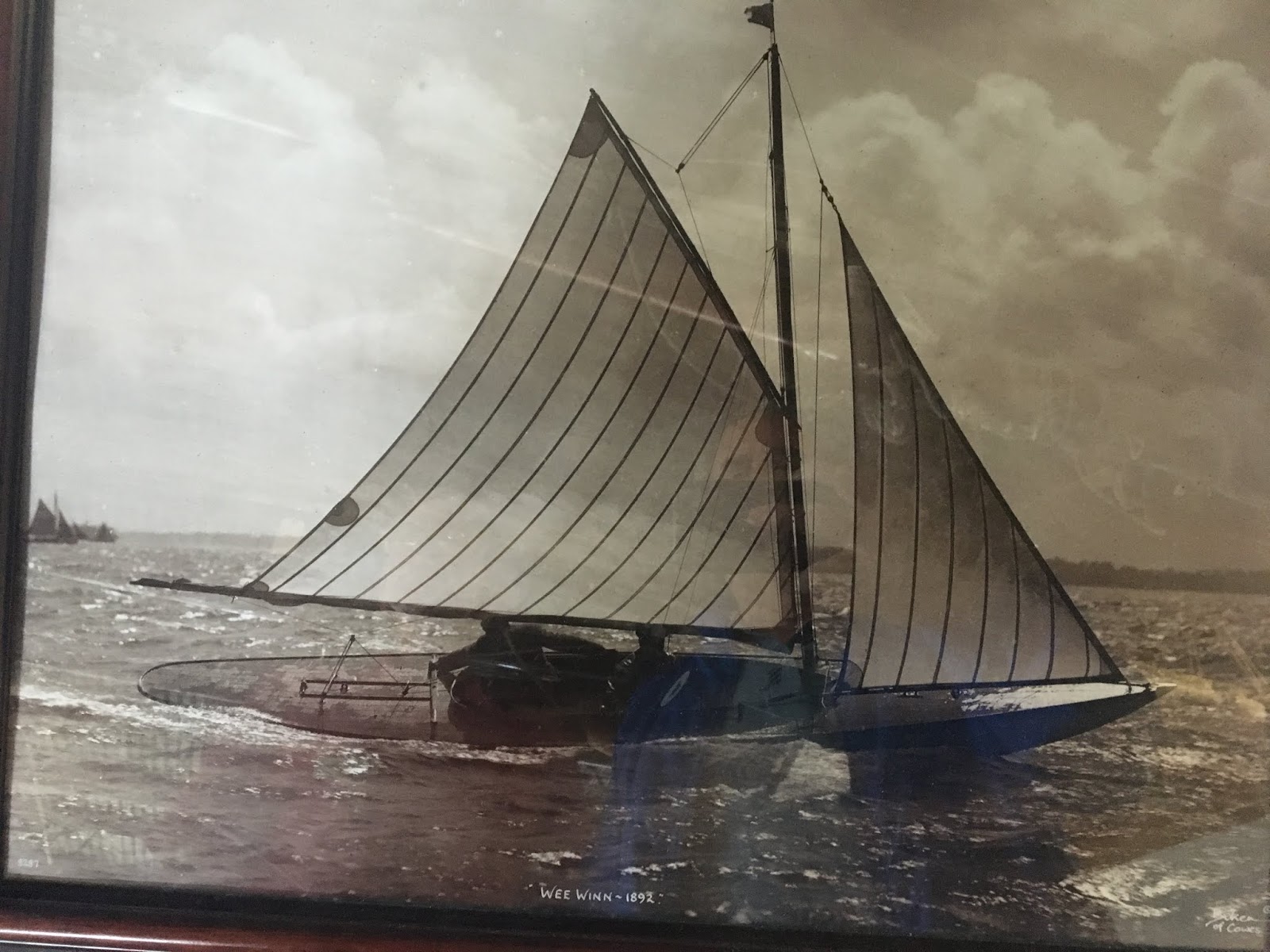
I was gathered up by Bill, one of the docents, and he gave me a great tour of the collection and workshop. First stop was WEE WINN, an 1892 1/2 Rater keel fin sloop, raced by Miss Winnifred Sutton over in England, she cleaned up 20 of 21 matches.
There is a good webpage that lists all of the collection's boats, open another tab and
click on the link to have a handy reference as I take you on a speed pass. My focus was the small boats, ones that I could tow behind our van, and a few other select boats. I had a list and Bill made sure we saw all of them, plus a few more.
More on WEE WINN later. We went to over to another 15 Class, like FIREFLY at the airport, one that Bill had owned at one point. She looks fast just sitting there and has beautiful lines.
Next was EAGLET, a lapstrake sailing tender, centerboarder built 1916.
Something shiny over here, a kayak named ATTU, built 1944 from a ASDeWH design.
Back to EAGLET.
I'm not sure where ANKLE DEEP fits in the collection, but she looks mighty fine.
A peek overhead at AMARYLLIS' daggerboard trunk, more on her later. My camera battery was running low so I only snapped a few shots on the first pass, then came back later for a few more after a recharge
1859 SPRITE, Herreshoff's oldest hull and one of the oldest catboats ever designed.
AMARYLLIS II, built 1933 from NGH's 1875 design.
The Herreshoff 12 1/2, one of the most popular designs.
Bill was a great tour guide, having owned and sailed many Herreshoff designs.
Upstairs to look at the car and tiller on AMARYLLIS II.
Looking down at the 12 1/2 BULLDOG.
Next we got into detail shots on the small tenders.
JACK
GEM
COLUMBIA's tender
Next we went across the street to check out the workshop. On the way we saw a nice little 12 1/2 for sale, ZEPHYR.
We stumbled across Dan Shea, moving his shop to a bigger location and getting ready to expand his educational programs. He is the owner of Bristol Boat Company and has a
great facebook page.
Next stop was the workshop, where volunteers were working on a steam launch exhibit model. The sides are cut out so the kids can see the setup.
Boiler and engine.
CHarged the camera and back into the main exhibit hall. AMARYLLIS II again, we find her fascinating.
PLEASURE, Capn Nat's Florida centerboarder.
WEE WINN.
SPRITE.
COQUINA with mizzen removed.
Rudder derigged for transport.
Sail loft display.
Then it was time for the NC-4 lecture. We had a great host and a great crowd, nice reception, lots of good questions. Afterwards we were invited up to the model room to see the NC-4 model. I had snapped a few pictures from outside earlier, not being sure if the room would be open later.
The NC-4 model is a beautiful ship, built in 1995, powered by electric motors, the builder was kind enough to donate it to the Museum. While I was looking at the model i had the good fortune to meet Mr. Halsey Herreshoff, a skilled America's Cup sailor and former President of the Museum. He lives nearby and comes over to work in the model room and check on the special events. We had a nice chat and he expressed an interest to come visit NC-4 down in Pensacola!
The half models in the room date back to the late 1800s, so the room is temperature and humidity controlled, and not always open to the public. There was a very interesting catamaran model from the 1870s, paper hulls, one of Herreshoff's "first composites" was how Mr. Herreshoff described it. He said the design was inspired by the proa next to it.
We wrapped up the evening with a discussion about catamarans and their sister ships down on the Gulf Coast. There were about 20 various sizes built and some may have migrated south, as the concepts show up in regattas around the same time period.
19 Sep 19:
See you next time PRIM!
I can't thank the folks at HMM enough for their hospitality and the opportunity to talk about one of my favorite aircraft. And can't wait to get back to visit again soon with the Skipper. The lecture was recorded and it will be uploaded soon to their website, we'll post the link as soon as that happens. In the meantime, I highly suggest that you plan a visit to this great facility.
Thanks for reading,
Clark
FMI:
Museum Collection List of Boats
Herreshoff Marine Museum